Cristo Rey del Cubilete, Guanajuato
A 22-metre bronze statue of Christ stands on the summit of Cerro del Cubilete, a mountain that rises 2,570 metres above sea level at the geographic centre of Mexico. The statue is visible from across the Bajío plains, arms outstretched against the sky, a landmark that draws both pilgrims and visitors to one of the most significant religious sites in the country.
Cristo Rey is not simply a monument. For Mexican Catholics, this mountaintop represents faith tested by persecution and rebuilt in defiance. The statue that stands today is the second on this site. The first was destroyed by government bombs during one of the bloodiest religious conflicts in modern Mexican history.
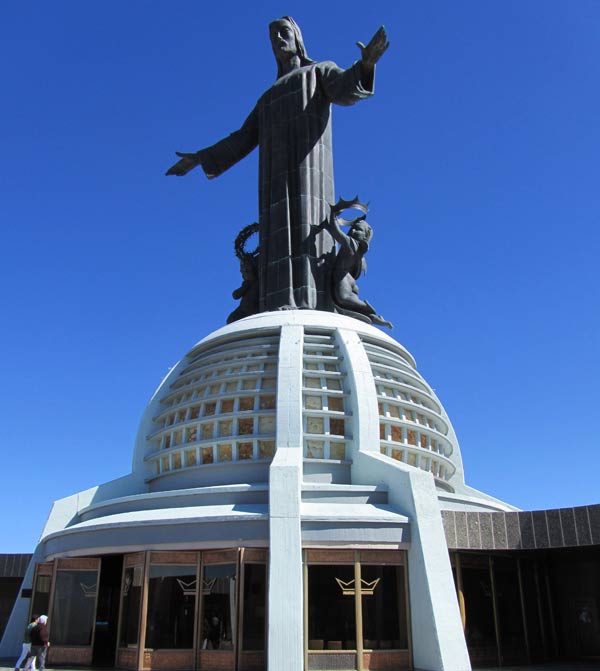
The “Cristo Rey” Statue in Guanajuato
The Monument
The statue depicts Christ as King, his arms open wide in a gesture of embrace. Two bronze angels flank him at the base: one holds a royal crown, the other carries the crown of thorns. The contrast between the two crowns captures the Catholic theology of Christ as both divine ruler and suffering redeemer.
The figure stands not on a conventional plinth but on the roof of a church. The Santuario de Cristo Rey is built into the mountaintop itself, its structure taking the form of a globe representing the world. The design is Art Deco in style, constructed from concrete and volcanic stone, with a circular interior that feels unlike any conventional church. Mass is held here daily, and the building functions as an active place of worship rather than simply a base for the monument above.
The statue weighs 80 tonnes and rises 22 metres from its base. The total height from the church floor to the top of Christ's head exceeds 40 metres, and the position on the 2,570-metre peak makes the monument visible for dozens of kilometres in every direction. Cristo Rey faces the city of León rather than Guanajuato or Mexico City. This orientation reflects the source of the monument's funding: the diocese and cathedral of León, which remains the religious centre of Guanajuato state.
The Cristo Rey’s Troubled History
The first statue of Cristo Rey was erected in 1923, a modest two-metre stone figure placed on the same mountaintop. It stood for just three years.
In 1926, President Plutarco Elías Calles launched a campaign to break the power of the Catholic Church in Mexico. The government closed churches, expelled foreign priests, and banned religious education. Catholics across the country, particularly in the deeply devout Bajío region, rose in armed revolt. The conflict that followed became known as the Cristeros War.
The original Cristo Rey was an early target. Government forces destroyed the statue by aerial bombardment, part of a systematic campaign against religious monuments. The war continued until 1929, leaving an estimated 90,000 dead and fracturing the relationship between church and state for decades.
The current statue was inaugurated in 1940, designed by sculptor Fidias Elizondo and built by architect Nicolás Mariscal Piña. The Mexican government contributed to the funding, a gesture of reconciliation with a church that remained powerful despite years of persecution. The scale of the new monument, vastly larger than the original, made a statement that the faith of the Bajío could not be bombed into submission.
Pilgrimage to the Cristo Rey
Cristo Rey draws pilgrims throughout the year, though no miracle or apparition has ever been reported here. The site's significance is historical and symbolic rather than supernatural: it represents Catholic survival through persecution.
The devotion of pilgrims is visible in how they approach the summit. Many complete the final stretch of the climb on their knees or crawling, acts of sacrifice offered in hope that prayers will be answered. The steps and paths near the top are worn smooth by decades of this practice.
Two dates bring the largest crowds. In early January, typically between the 5th and 11th, thousands of cabalgadores ride on horseback from across Mexico to the summit. The sight of cowboys in traditional dress ascending the mountain on horseback is one of the most striking religious traditions in the country, though the crowds make this period challenging for casual visitors. The Feast of Christ the King, held on the last Sunday before Advent (24 November in 2026), is the most important liturgical celebration at the sanctuary and draws enormous numbers of worshippers.
The View at the Cristo Rey
The summit offers 360-degree views across the Bajío, the fertile highland plain that forms the agricultural and industrial heartland of central Mexico. On clear days, the city of Silao spreads out directly below, with León visible to the northwest and the mountains of the Sierra de Guanajuato rising to the east. The position at the geographic centre of the country means you stand equidistant from the Pacific and Gulf coasts, from the northern deserts and the southern highlands.
The wind at this altitude is significantly stronger and colder than in the valleys below. Even when Guanajuato city feels warm, the summit can be biting. A windbreaker or light jacket is worth carrying regardless of conditions at the base.
Visiting Cristo Rey
The mountain lies 15 kilometres west of Guanajuato city, but the winding road climbs nearly 1,000 metres from the valley floor. The journey takes approximately one hour, longer if traffic is heavy on the narrow mountain road. The road surface is fully paved but includes sections of cobblestone designed to provide grip during the rainy season.
Several transport options serve the route. Unebus operates regular services from both Guanajuato and Silao, with fares ranging from 50 to 130 pesos depending on your starting point. A private taxi for the round trip, including waiting time at the summit, typically costs 700 to 900 pesos. Solo travellers and couples often find group tours the most practical option, with prices running from 150 to 300 pesos per person.
At the base of the mountain, the Parador Turístico Sangre de Cristo provides a modern visitor complex worth building into your trip. Three museums occupy the site. The Museum of Travelling Mummies displays 36 preserved bodies that once formed part of a touring exhibition, separate from the more famous mummy collection in Guanajuato city. The Catrinas Museum explores the history of La Catrina and Day of the Dead traditions through colourful displays. The Mining Museum offers an interactive look at the silver extraction that built the region's wealth. Each museum charges a small entrance fee, typically around 100 pesos.
Admission to the sanctuary itself is free. The site is open daily, though arriving early helps avoid both the heat of the climb and the crowds that build through the afternoon.
Guanajuato Mexico Tourist Guide Navigation
 -
-


